

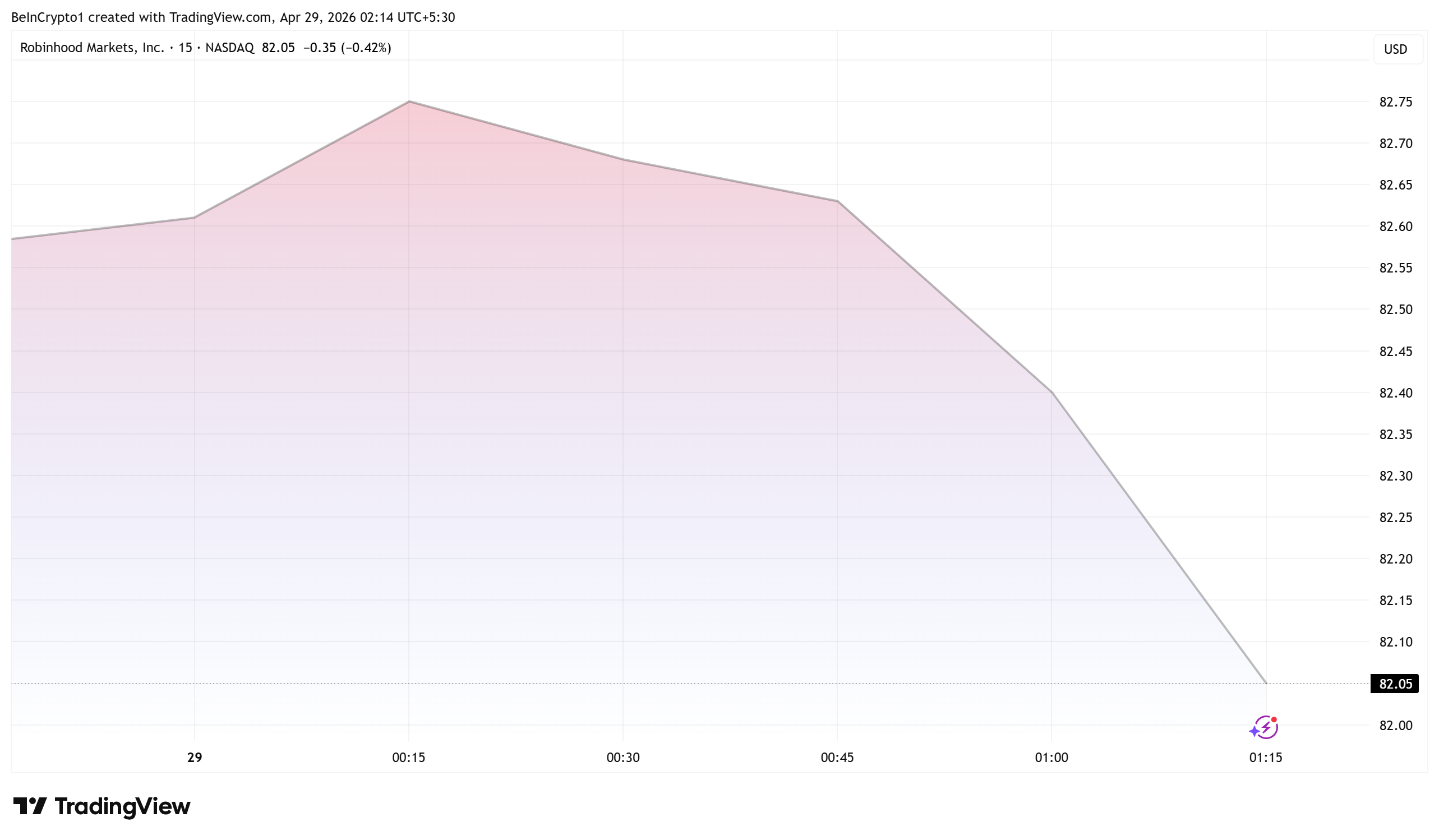
Robinhood Markets shares slipped about 6% in after-hours trading Tuesday after the retail brokerage reported a 34% quarterly drop in cryptocurrency revenue, dragging overall first-quarter results below Wall Street expectations.
The Menlo Park firm posted $346 million in first-quarter profit, or $0.38 per share, narrowly missing analyst estimates of $0.39 even as earnings rose 3% from a year earlier.
Crypto Revenue Slides as Bitcoin Cools
Crypto transactions generated $134 million in revenue during the quarter, down from $221 million in the prior period. Bitcoin (BTC) fell 22% over the same window.
Total revenue reached $1.07 billion, short of the $1.14 billion analysts had projected. The miss arrived even as equities, options, futures, and prediction markets posted double-digit growth or record volumes, the company said.
Trading fees drove much of the platform’s gains last year, when HOOD stock peaked at $153.86 in October alongside crypto’s broader run.
Robinhood stock dipped on this report, and was trading for $82.05 as of this writing.
Prediction Markets and Tokenization Cushion the Slide
Chairman and CEO Vlad Tenev pointed to the firm’s expanding role across customer finances in a statement.
“Robinhood is increasingly positioned at the center of our customers’ financial lives,” he stated in the broadcast.
Wagers routed through Kalshi-powered prediction markets logged record volumes, supported by a one-cent transaction fee.
Robinhood also launched the public testnet for Robinhood Chain, an Ethereum (ETH) layer-2 network built around tokenized assets.
Total platform assets stood at $307 billion, down from $324 billion at the end of last year but 39% higher year-over-year.
The European tokenized stocks product, which offers exposure to private companies including OpenAI and SpaceX, has processed more than 100 million transactions since launch.
The after-hours sell-off pushed HOOD to roughly $82, well off the October peak. The path forward depends on whether prediction markets and tokenization can offset the cooling in digital asset trading.