

Solana Foundation is trying to turn pro-trader subsidies into chain-level market structure.
With Frontier Traders, the Foundation introduced a program on June 17 that aggregates activity across Solana venues, offers VIP rebates, and covers priority infrastructure for qualified users.
The package moves Solana’s pitch closer to the way large trading venues compete for serious flow: better economics, better support, and lower operating friction.
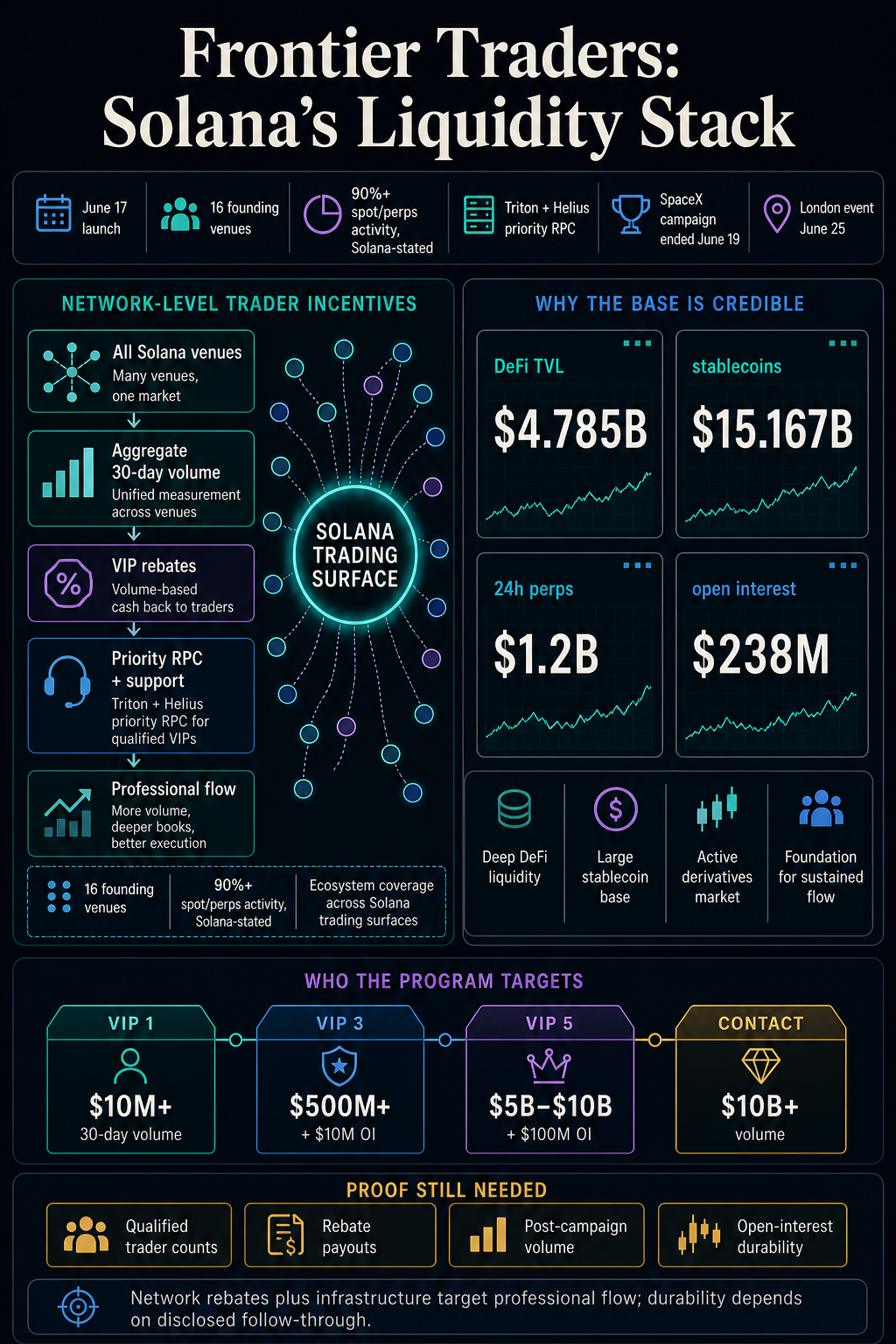
The subsidy sits at the network layer. Frontier aims to make Solana itself the trading surface by tracking activity across the network and rewarding traders who drive flow through the ecosystem.
Solana is trying to make the chain the venue
Traditional VIP programs are usually venue-specific. A trader earns a higher fee tier on a centralized exchange by sending enough volume to that exchange.
Frontier changes the unit of competition by tracking aggregate trading activity across all Solana venues and offering qualified VIPs rebates at any venue, according to Solana’s announcement.
A chain can package many venues into a single professional trading surface, with the rebate as the visible incentive and a service layer for routing, support, and infrastructure.
The deeper offer is a promise that traders can work across Solana with some of the operational treatment they expect from large centralized venues.
The program site identifies the target users as market makers, high-frequency and prop trading firms, principal market makers, and sophisticated independent traders.
It lists priority RPC, dedicated account management, early access to product launches, direct introductions, peer events, and structured roadmap input among the benefits.
That mix turns Frontier into a professional habit-formation tool. The test is whether those desks begin treating Solana liquidity as a single place to deploy capital across venues that would otherwise have to win flow one by one.
The taker VIP thresholds show how large the target traders are. VIP 1 begins at a minimum of $10 million in 30-day volume.
VIP 2 starts at $100 million and adds at least $5 million in open interest. VIP 3 requires at least $500 million in 30-day volume and at least $10 million in open interest.
VIP 4 requires at least $2 billion and at least $25 million in open interest. VIP 5 requires at least $5 billion and less than $10 billion in 30-day volume, plus at least $100 million in open interest.
Solana asks firms expecting more than $10 billion in volume to contact the program.
Those thresholds target firms capable of materially influencing venue liquidity: takers moving consistent size, makers keeping spreads competitive, and traders whose routing decisions can help determine whether on-chain venues feel liquid enough for others to follow.
Solana also said the founding program venues account for more than 90% of Solana spot and perpetuals trading activity.
The launch list includes Jupiter, Phoenix, Raydium, Backpack Securities, Orca, Byreal, Phantom, Fomo, Titan, Dflow, Pump.fun, Axiom, Meteora, Ondo, xStocks, and OKX DEX.
The breadth of that list is part of the strategy. It provides Frontier coverage across a large share of Solana’s listed trading surfaces and enables the program to present fragmented activity as a single commercial package for traders who measure execution quality across venues.

The launch also brought immediate deadlines. Solana said Frontier kicked off with a SpaceX trading campaign offering $25,000 in prizes for the top 100 traders by $SPCX volume through June 19.
The next event is scheduled for June 25 in London.
Infrastructure turns rebates into execution support
The rebate program gets the easiest attention, while the infrastructure benefit sends the sharper signal for the audience Solana is chasing.
Qualified VIP members can receive technical support and warm introductions to teams that can help them go live on Solana. The Foundation also said its initial priority RPC program is in partnership with Triton and Helius.
Frontier’s tier table indicates priority RPC is included for VIP 3 and above, making the Triton and Helius access a qualified VIP feature rather than a general membership perk.
For a retail user, RPC access may sound like plumbing. For a trading desk, it is execution infrastructure.
Helius markets a global Solana RPC across 11 regions with sub-100-millisecond latency, priority fee estimation, and production workloads.
Triton’s Pro Trading Centers describe Amsterdam and Tokyo setups designed for low read and write latency, co-location, validator routing, and Geyser streams, enabling trading software to react up to 400 milliseconds faster than standard RPC services.
The value of that support goes beyond fee relief. Migrating a professional strategy depends on day-to-day reliability: transaction visibility, fee estimation, routing relationships, and access to teams that can troubleshoot before slippage or latency turns into trading cost.
By bundling those services with rebates, Solana is treating liquidity as much an operations problem as a fee problem.
That makes Frontier more than a rebate schedule. It is a package of execution economics and technical support aimed at reducing the friction that keeps professional firms on centralized infrastructure even when on-chain venues offer assets or settlement patterns they want.
Account coverage and technical escalation sit beside fee tiers, which is the part of the program that most clearly tries to make on-chain trading feel institutionally serviced.
For desks deciding whether to move strategies on-chain, that combination lowers the number of separate relationships they need to establish before testing size through Solana venues.
Solana is making that pitch against a liquid but uneven market backdrop.
SOL traded around $69.20, ranked seventh by market cap, with roughly $40.1 billion in market value and about $2.3 billion in 24-hour trading volume.
The same market snapshot showed SOL down about 17% over 30 days and roughly 19% over 90 days, putting the launch against a weaker medium-term token chart.
DeFiLlama listed about $4.74 billion in Solana DeFi TVL and about $1.5 billion in 24-hour DEX volume.
Its stablecoin view puts Solana stablecoins at near $15.2 billion, with USDC at around 48% dominance, while its perps view showed about $1.6 billion in 24-hour perps volume and roughly $351 million in open interest.
Durable flow is the next test
That base gives Frontier enough flow, stablecoin liquidity, and derivatives activity to target for a professional incentive program.
Durability is the open issue. DeFiLlama also showed weekly declines in Solana DEX and perps volume on June 20, so the program has to show it can keep high-quality flow after campaign prizes and rebates fade into routine economics.
That caveat fits a broader tension in Solana that CryptoSlate has already tracked. In a recent analysis of why SOL was falling despite ETF inflows and activity, CryptoSlate noted that fees, stablecoin flows, tokenized equity volume, and perps can benefit validators, issuers, platforms, and market makers before they reach SOL holders.

Frontier could deepen the professional trading layer while leaving open who captures the economics.
The program terms keep the launch in scope: the Solana Foundation does not endorse the listed protocols, participants assume protocol and trading risks, and the sponsor can modify, suspend, or terminate eligibility or rewards.
Those limits keep the launch grounded. Frontier is a coordinated attempt to make on-chain trading feel more institutionally serviced, but it leaves unresolved whether participating venues become safer, whether traders migrate from centralized venues, and whether activity becomes organic once incentives settle.
Solana is testing whether a public blockchain can compete for professional flow at the same layer centralized exchanges already understand: fee tiers, account management, technical support, events, and privileged infrastructure.
The difference is delivery. Solana is trying to provide those benefits across an ecosystem rather than within a single corporate venue.
Evidence to watch now includes disclosed qualified trader counts, actual rebate payouts, open-interest durability, repeated venue volume after campaigns, and signs that centralized-exchange desks are moving strategies on-chain.
Strong follow-through would suggest that public chains act as coordinated trading networks for professional capital. Weak follow-through would make Frontier look like another layer of incentive buying volume that traders were happy to sell.
com”>CryptoSlate.