

Aave is approaching a $67 million collateral rollover as one of its fastest-growing fixed-yield trades reaches maturity.
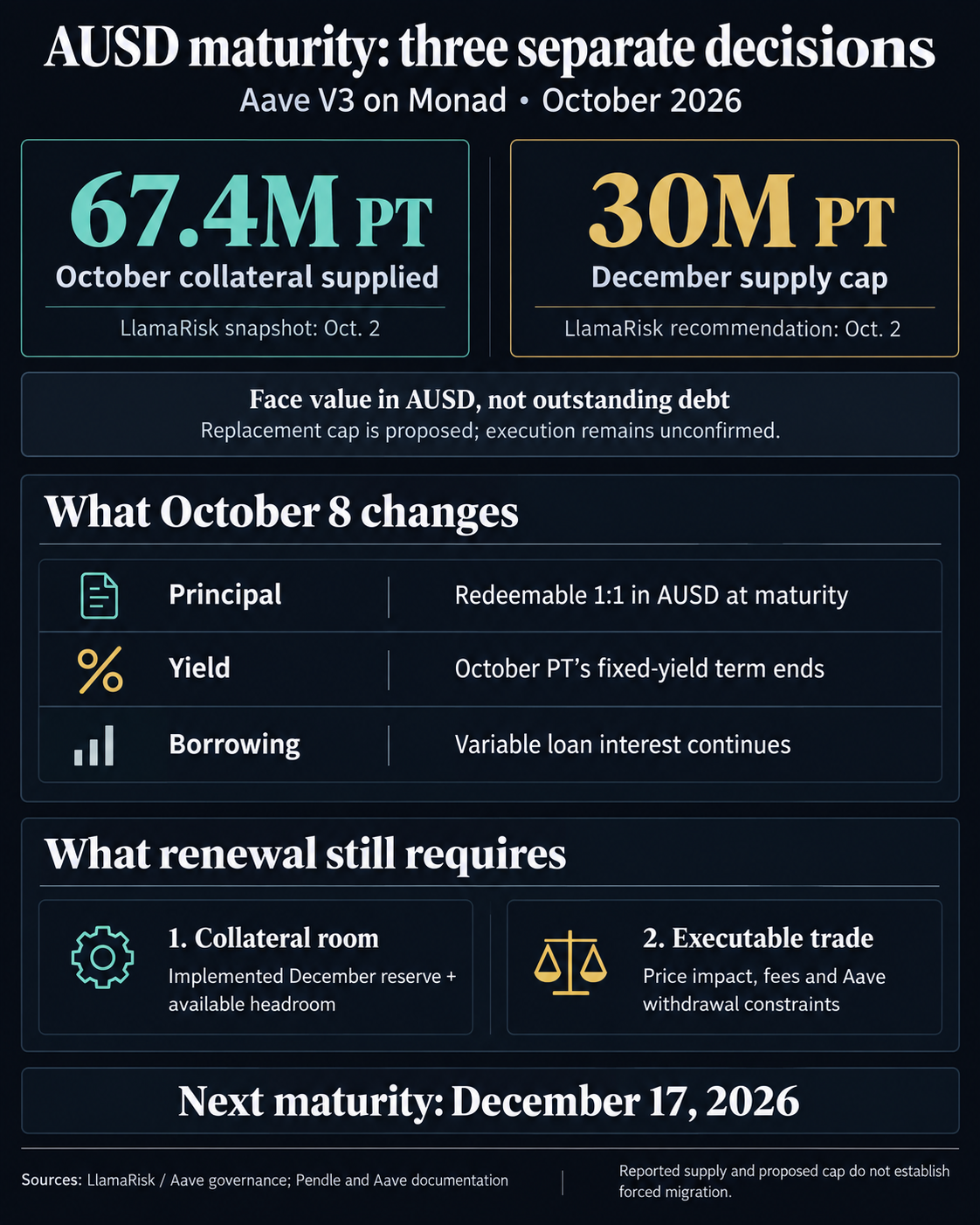
About 67.4 million PT-AUSD-8OCT2026 tokens were supplied as collateral on Aave V3’s Monad market as of Oct. 2, according to risk adviser LlamaRisk. The Pendle principal tokens mature Oct. 8, when each becomes redeemable for one AUSD and its fixed-yield appreciation ends.
A replacement is already being prepared. Pendle deployed a Dec. 17 AUSD principal-token market last month, and TokenLogic has proposed listing it on Aave so borrowers can move into the next maturity without giving up the collateral utility that helped the October market expand.
The timing coincides with accelerating demand for AUSD credit on Monad. On Oct. 3, TokenLogic said active AUSD loans on Aave jumped 113% to $8.7 million from $4.1 million in 15 days, while user deposits more than doubled to $11.2 million.
That creates an emerging cycle between Pendle’s fixed-yield markets and Aave’s lending infrastructure. Investors can lock in a return through PT-AUSD, use the position as collateral to borrow stablecoins, and then move into a later-dated PT when the original token matures.
“Fixed yield becomes collateral. Collateral creates credit. Then the next maturity keeps the cycle moving,” DeFi researcher Andree said, while describing the relationship between the protocols.
The Oct. 8 expiry will provide the first large-scale test of whether that cycle can continue across maturities.
A $20 million market grew past $67 million
The October PT began with considerably less capacity than it ultimately attracted.
Aave initially launched the collateral market with a 20 million-token supply cap. Users filled it by late August, prompting LlamaRisk to recommend an increase to 40 million. That limit was also fully utilized within days, leading the risk adviser to recommend another increase to 80 million.
By Oct. 2, 67.4 million PT was supplied.
The rapid cap expansions show why the proposed December market size should not be treated as a permanent ceiling. TokenLogic proposed another 20 million initial cap for PT-AUSD-17DEC2026, while LlamaRisk recommended starting at 30 million.
That is less than half the amount sitting in the expiring market, but the October precedent shows Aave can expand capacity if demand, liquidity, and borrower health justify it.
LlamaRisk explicitly described the December PT as the rollover destination for the October position and said as much as 67.4 million of Aave collateral could potentially migrate into it.
The October market also shows that much of the supplied PT has been used actively rather than left idle. In an Aug. 31 assessment, LlamaRisk found that the 18 largest suppliers all carried debt, primarily in USDC, with additional borrowing in GHO, USDe and USDT0.
Their median health factor was 1.02 at the time. The tight margin reflected a structure in which both the collateral and debt are dollar-denominated, allowing borrowers to run high loan-to-value positions with less directional price risk than crypto-backed leverage.
Maturity does not itself trigger liquidation. Borrowers can redeem PT for AUSD after expiry, repay loans, or post other collateral. But a user with debt against the October PT cannot necessarily withdraw the collateral until the position remains adequately covered.
Rolling directly into December PT offers another route to keeping the borrowing position intact.
The next market still has to scale
The more immediate constraint may come from the maturity of the replacement market itself.
As of Oct. 2, the December Pendle pool had just $1.61 million of liquidity, 904,717 PT outstanding and $44,000 of trading volume since deployment, according to LlamaRisk.
Those figures are small compared with the tens of millions of dollars held in the October position.
Pendle users can mint additional PT by splitting yield-bearing AUSD positions into principal and yield tokens, meaning existing pool liquidity does not impose a hard limit on how much collateral can eventually be created. Large-scale migration can still affect execution prices and the fixed return available to buyers.
The economics are already tighter than when the October market began.
LlamaRisk put the December PT’s implied yield at 5.64% on Oct. 2. A temporary one-percentage-point campaign incentive lifted the effective rate to 6.64%.
That exceeded borrowing rates of 4.28% for mUSD, 4.64% for GHO, 5.10% for USDT0 and 6.09% for USDC at the snapshot, leaving room for positive carry before transaction costs and price impact. It remained below the 6.82% borrowing rate on USDe.
Those spreads can change quickly. Aave borrowing rates vary with utilization, while PT yields move as traders buy or sell the instrument. The incentive boosting December returns is also temporary.
The surge in AUSD borrowing adds another dimension to the rollout. The $8.7 million of active AUSD loans is separate from the stablecoin debt raised specifically against PT-AUSD, but both point to growing demand for AUSD-linked credit on Monad.
Keeping the principal token usable across successive maturities could help keep fixed-yield capital in Aave after each Pendle market expires.
The next few days will show how much of the October collateral actually attempts to make that transition.
If December PT begins filling its initial cap as rapidly as the October version did, Aave’s risk stewards may again face pressure to raise the limit. Their willingness to do so will depend on Pendle liquidity, borrower health, and whether the new market develops enough depth to support tens of millions of dollars of collateral.
For borrowers, the decision will be more immediate: repay at maturity, replace the collateral or secure space in the December market while the yield spread remains attractive.
com”>CryptoSlate.